Design
that ships.
Research, UX, UI and design systems for software products. We turn fuzzy problems into screens engineers can build — and we work side by side with the team that ships them.
An index of services.
Six things we do every week. They overlap and compose into the engagement you actually need — not always a tidy package.
Product discovery & research.
Stakeholder interviews, user research, competitive teardowns. We arrive with questions and leave with a written point of view.
UX, flows & wireframes.
Information architecture, user flows and lo-fi screens. Pressure-tested againstreal edge cases before any pixel goes hi-fi.
UI design& visual language.
Hi-fi screens with type, colour, spacing and motion. A visual identity that feels deliberate, not decorative.
Design systems.
Reusable components, tokens and documentation in Figma. Built so engineering can mirror the structure 1:1 in code.
Prototyping & usability.
Click-through prototypes for key flows. Five-user usability rounds when the call is unclear and decisions need evidence.
Engineering handover.
Specs, redlines and a working relationship with developers. We stay involved until what was designed is what shipped.
What lands in your drive.
Real artefacts, not slideware. Each engagement produces a working set of files your team owns and engineers can build from.
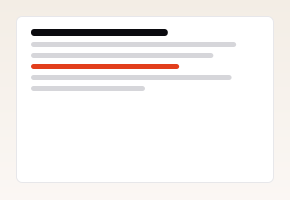
Findings memo
Written brief: who, what hurts, what tobuild first.
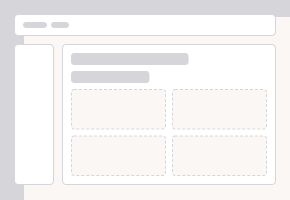
Wireframe set
Every screen, every state, lo-fi. Engineers can scope from this.
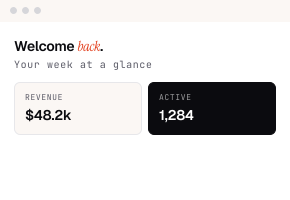
Hi-fi screens
Polished UI in Figma. Real content, real states, ready to build.
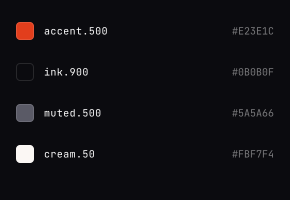
Tokens & library
Tokens, components, usage docs —versioned and yours.
A six-week rhytm.
Most projects move through the same four beats. Sprints compress this; embedded engagements loop through it continuously.
Discover. Learn the product.
We meet your team and your users. Stakeholder calls, a competitive sweep, and a written brief that everyone signs off on before any design happens.
Define. Shape the work.
IA, flows and wireframes. We agree on what is being designed, in what order, before pixels start. This is also where edge cases and empty states get decided.
Design. Pixels with content.
Hi-fi UI in Figma against real copy and real data. Reviews every two or three days, not every two weeks — it’s how directions get caught early.
Deliver. Into engineering.
Specs, system docs and pairing through to launch. We do design QA on the live build so what shipped is what we drew.
Three principles we keep.
Not a manifesto. A short list of things we keep arguing for, in every project, on every team.
Design with engineers, not at them.
Designers and engineers in the same Figma file, the same calls, the same Slack channel. Specs are a fallback, not the medium.
Real content beats lorem.
We design with your data, your copy, your edge cases. Empty, error and overflow states are part of the work— not an after thought.
A system earn its keep.
We build the system the product actually needs — not a museum piece. If a component is used twice, it gets a name. If once, it stays a screen.
Three shapes of project.
Every engagement starts with a call. Pricing depends on scope and team — written estimate after we’ve talked.
Design sprint
A focused effort on a single problem: a flow, a feature, a small redesign. Best when the question is sharp.
Recent design work
Three pieces from the last twelve months. Full case studies live in Work.
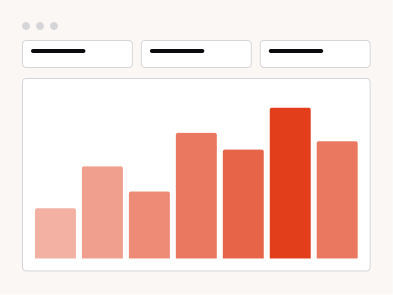
Northwind Analytics
Rebuilt the operator dashboard around four daily jobs.
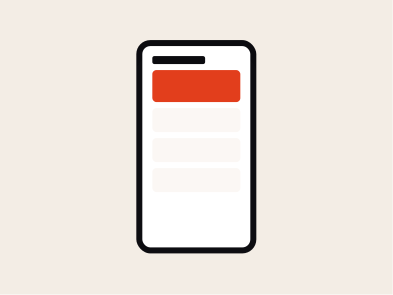
Pelican Banking
An onboarding flow that cut drop-off by 38% in eight weeks.
Helix Marketing site
A new brand and a marketing site shipped in five weeks.
Frequently asked.
Do you only design, or can you also build it?
Both. We can hand off to your engineers, or pair up with our Full Stack and Product Engineeringteams to design and ship in one engagement.
Do we get the Figma files?
Yes — all source files are yours. At the end of every project you receive fully organised Figma files with components, auto-layout, and documented design tokens so your team can maintain and extend the work independently.
Can you work without a research phase?
We work on a fixed-scope or time-and-materials basis depending on what fits the project best. After an initial call we send a clear proposal with scope, timeline, and cost — no surprises.
Do you build design systems from scratch?
Yes. We build scalable design systems from the ground up — foundations, component libraries, usage guidelines, and Figma libraries that sync with your codebase. We can also audit and extend an existing system if you already have one in place.
How do you charge?
We work on a fixed-scope project basis or a flexible monthly retainer — whichever fits how your team operates. We scope projects after a brief discovery conversation so there are no surprises. No hourly billing, no hidden fees.
Where are you based?
We're fully remote and distributed across Europe and North America. We work async-first, but align to your timezone for live sessions. Wherever you are, collaboration stays smooth.